Science Television
The Beauty and Complexity of the
Mandelbrot Sets
by John H. Hubbard
Copywright 1989
Running time 73 min.
This video will soon be available as a DVD from CustomFlix of
Amazon.com
The entire program can be seen in seven segments with
commercials via Revver.com.
View The Beauty and Complexity of the Mandelbrot Set via
Revver.com.
Description
In this richly illustrated video-lecture John H. Hubbard of
Cornell University discusses computer graphics which are the
subjects of much current research in pure mathematics. The
talk combines real time computer experiments, slides and
video to explain the origin and meaning of these remarkable
pictures.
Prof. Hubbard begins by describing the process of iteration and
its place in the history of mathematics. He then shows how it is
used to create pictures of Julia sets.
Part II of the lecture is devoted to the Mandelbrot set and the
computer program used to draw it. Hubbard uses his computer
to demonstrate the relationship between the Mandelbrot set
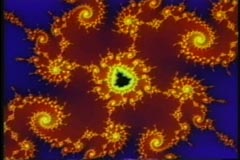
and Julia sets. He then shows a supercomputer animated zoom
into a portion of the Mandelbrot set's boundary which reveals
an extraordinary richness of detail.
In conlusion, Prof. Hubbard makes a few remarks about the
philosophical significance of these pictures and programs
especially with regard to the field of genetics.
The University Edition contains an additonal section called Part
III which discusses the character of the electric fields which
would surround electrically charged objects shaped like Julia
sets and the Mandelbrot set. The other sections and conluding
remarks are idential to those contained in the School Editon.
The downloadable version was previously referred to as the
University Edition, users may simply skip Part III, Electric Field
Lines and go right to the Conclusion for a shorter, less
mathematically advanced program that lasts only 45 minutes
and is suitable for use in High School classes.
Reviews
Mathematics Teacher, April 1991
(This is a review of the School Edition only.)
This videtape is aimed at those who have at least some
familiarity with calculus and complex variables. It was directed
and produced by Gary Welz of Science Television Company,
whose Chaos, Fractals and Dynamics was reviewed in the
October 1990 issue of this journal.
In the first half of this two-part lecture, John H. Hubbard,
professor at Cornell University, discusses the use of Newton's
method for finding roots of an equation. He demonstrates that
different initial approximations may cause the sequence to
converge to altogether different results. This one-dimensional
illustration of the complexity that can result from an iterative
method is simple and convincing, but it does not produce
particularly interesting pictures. So Hubbard next considers
iterations of a simple quadratic function in the complex plane
to produce striking color slides of the resulting Julia sets.
In Part 2 of the lecture, Hubbard uses a simple computer
program, run over many hours on a supercomputer, to
generate a Mandelbrot set and then to zoom into a particular
point on its boundary. No one, regardless of level of
mathematical sophistication, could fail to be amazed by this
strange and beautiful sequence. For this reason, I would not
hesitate to show it to high school students as an example of
the pleasure and excitement that further study of mathematics
can hold
Hubbard concludes his talk with the intriguing observation that
since the incredible complexity of the Mandelbrot set was
generated from such a simple program, it is reasonable to
suppose that other complex phenomena, such as the range of
biological diversity, may spring from an equally simple - and
hence understandable - program within DNA.
Lionel Garrison, Horace Mann School, Bronx, NY 10471
Mandelbrot Sets
by John H. Hubbard
Copywright 1989
Running time 73 min.
This video will soon be available as a DVD from CustomFlix of
Amazon.com
The entire program can be seen in seven segments with
commercials via Revver.com.
View The Beauty and Complexity of the Mandelbrot Set via
Revver.com.
Description
In this richly illustrated video-lecture John H. Hubbard of
Cornell University discusses computer graphics which are the
subjects of much current research in pure mathematics. The
talk combines real time computer experiments, slides and
video to explain the origin and meaning of these remarkable
pictures.
Prof. Hubbard begins by describing the process of iteration and
its place in the history of mathematics. He then shows how it is
used to create pictures of Julia sets.
Part II of the lecture is devoted to the Mandelbrot set and the
computer program used to draw it. Hubbard uses his computer
to demonstrate the relationship between the Mandelbrot set
and Julia sets. He then shows a supercomputer animated zoom
into a portion of the Mandelbrot set's boundary which reveals
an extraordinary richness of detail.
In conlusion, Prof. Hubbard makes a few remarks about the
philosophical significance of these pictures and programs
especially with regard to the field of genetics.
The University Edition contains an additonal section called Part
III which discusses the character of the electric fields which
would surround electrically charged objects shaped like Julia
sets and the Mandelbrot set. The other sections and conluding
remarks are idential to those contained in the School Editon.
The downloadable version was previously referred to as the
University Edition, users may simply skip Part III, Electric Field
Lines and go right to the Conclusion for a shorter, less
mathematically advanced program that lasts only 45 minutes
and is suitable for use in High School classes.
Reviews
Mathematics Teacher, April 1991
(This is a review of the School Edition only.)
This videtape is aimed at those who have at least some
familiarity with calculus and complex variables. It was directed
and produced by Gary Welz of Science Television Company,
whose Chaos, Fractals and Dynamics was reviewed in the
October 1990 issue of this journal.
In the first half of this two-part lecture, John H. Hubbard,
professor at Cornell University, discusses the use of Newton's
method for finding roots of an equation. He demonstrates that
different initial approximations may cause the sequence to
converge to altogether different results. This one-dimensional
illustration of the complexity that can result from an iterative
method is simple and convincing, but it does not produce
particularly interesting pictures. So Hubbard next considers
iterations of a simple quadratic function in the complex plane
to produce striking color slides of the resulting Julia sets.
In Part 2 of the lecture, Hubbard uses a simple computer
program, run over many hours on a supercomputer, to
generate a Mandelbrot set and then to zoom into a particular
point on its boundary. No one, regardless of level of
mathematical sophistication, could fail to be amazed by this
strange and beautiful sequence. For this reason, I would not
hesitate to show it to high school students as an example of
the pleasure and excitement that further study of mathematics
can hold
Hubbard concludes his talk with the intriguing observation that
since the incredible complexity of the Mandelbrot set was
generated from such a simple program, it is reasonable to
suppose that other complex phenomena, such as the range of
biological diversity, may spring from an equally simple - and
hence understandable - program within DNA.
Lionel Garrison, Horace Mann School, Bronx, NY 10471
 |
| |
 |
| |
 |
| |
 |
| |
 |
| |
 |