Science Television
Sub Topic
Additional information
could go here.
Additional information
could go here.
S
The Art of Renaissance Science:
Galileo and Perspective
by Joseph W. Dauben
Copywright 1991
Running time 45 min.
This video will soon be available as a DVD from CustomFlix of
Amazon.com
Description
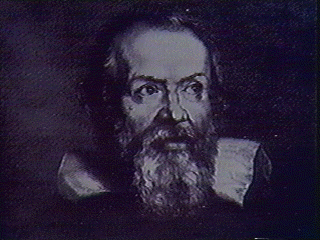
Prof. Joseph W. Dauben discusses the life of Galileo, the origin
of perspective drawing and the interaction of art and science in
the Renaissance. His presentation includes dozens of
examples from Renaissance painting, sculpture and
architectural drawing including the works of Rembrandt,
Michelangelo and Leonardo DaVinci.
Brunelleschi's famous discovery of linear perspective using
mirrors and the Baptistry of the Cathedral in Florence is
illustrated with overlays showing the horizon line and the
vanishing points.
Computer graphics are used to recreate the inclined plane and
Tower of Pisa experiments of Galileo. Dauben explains how
these experiments allowed Galileo to formulate his
revolutionary mathematical theory of the behavior of falling
bodies.
Dauben concludes by discussing the influence of Galileo's
scientific work on the artists of his time.
Reviews
The Satellite Scholar, January, 1994
"The underlying reality of the world we perceive with our bodily
senses, is a set of mathematical proportions." This fact was
one of the key discoveries of the Italian Renaissance. And how
it came about is cogently explained by the historian, Joseph
Dauben, in this superb film.
Focusing on the life of Galileo, Dauben explains how early
Renaissance painters had already begun to experiment with
visual perspective: rendering three-dimensional realities more
accurately on the canvas surface, and how this technique
spread to sculpture and architectural drawing. Finally, Galileo
and his experiments with falling bodies and projectile motion
attempted to explain motion in the universal language of
mathematics.
Using many additional examples from DaVinci, Michelangelo,
and Brunelleschi, plus computer graphics, the film
demonstrates how art and science grew from and fed one
another, in the amazing explosion of human awareness we call
the Renaissance.
Dauben's presentation is first-rate and likely to hold the
interest of a broad range of viewers.
Mathematics Teacher, September 1992
Documentation was not supplied with this videotape, but I
assume that the target audience is a college history class in a
science, mathematics, art, or interdisciplinary area.
This videotape presents a history of the development of
perspective drawing and its effect on the life andwork of
Galileo, as well as the art of the Renaissance. Excellent
highlights include graphics that illustrate Galileo's
inclined-plane experiments on gravity and Brunelleschi's work
on perspec- tive drawing.
The vocabulary is sophisticated, and the sentence structure
seems more appropriate for a text- book than for a videotape.
The content is valuable, but the ideas and connections some
too quickly to allow students to comprehend them, especially if
any of the ideas are new to students. Viewing this tape would
make a good closure activity if students had previously studied
the content.
Robert P. Stutts, Columbia College, Columbia, SC 29203
Galileo and Perspective
by Joseph W. Dauben
Copywright 1991
Running time 45 min.
This video will soon be available as a DVD from CustomFlix of
Amazon.com
Description
Prof. Joseph W. Dauben discusses the life of Galileo, the origin
of perspective drawing and the interaction of art and science in
the Renaissance. His presentation includes dozens of
examples from Renaissance painting, sculpture and
architectural drawing including the works of Rembrandt,
Michelangelo and Leonardo DaVinci.
Brunelleschi's famous discovery of linear perspective using
mirrors and the Baptistry of the Cathedral in Florence is
illustrated with overlays showing the horizon line and the
vanishing points.
Computer graphics are used to recreate the inclined plane and
Tower of Pisa experiments of Galileo. Dauben explains how
these experiments allowed Galileo to formulate his
revolutionary mathematical theory of the behavior of falling
bodies.
Dauben concludes by discussing the influence of Galileo's
scientific work on the artists of his time.
Reviews
The Satellite Scholar, January, 1994
"The underlying reality of the world we perceive with our bodily
senses, is a set of mathematical proportions." This fact was
one of the key discoveries of the Italian Renaissance. And how
it came about is cogently explained by the historian, Joseph
Dauben, in this superb film.
Focusing on the life of Galileo, Dauben explains how early
Renaissance painters had already begun to experiment with
visual perspective: rendering three-dimensional realities more
accurately on the canvas surface, and how this technique
spread to sculpture and architectural drawing. Finally, Galileo
and his experiments with falling bodies and projectile motion
attempted to explain motion in the universal language of
mathematics.
Using many additional examples from DaVinci, Michelangelo,
and Brunelleschi, plus computer graphics, the film
demonstrates how art and science grew from and fed one
another, in the amazing explosion of human awareness we call
the Renaissance.
Dauben's presentation is first-rate and likely to hold the
interest of a broad range of viewers.
Mathematics Teacher, September 1992
Documentation was not supplied with this videotape, but I
assume that the target audience is a college history class in a
science, mathematics, art, or interdisciplinary area.
This videotape presents a history of the development of
perspective drawing and its effect on the life andwork of
Galileo, as well as the art of the Renaissance. Excellent
highlights include graphics that illustrate Galileo's
inclined-plane experiments on gravity and Brunelleschi's work
on perspec- tive drawing.
The vocabulary is sophisticated, and the sentence structure
seems more appropriate for a text- book than for a videotape.
The content is valuable, but the ideas and connections some
too quickly to allow students to comprehend them, especially if
any of the ideas are new to students. Viewing this tape would
make a good closure activity if students had previously studied
the content.
Robert P. Stutts, Columbia College, Columbia, SC 29203
 |
| |
 |
| |
 |
| |
 |
| |
 |
| |
 |